

In loving memory of Nonna Marcella— forever linked to the scent of green tomato leaves, the deeply savory taste of stewed green beans, and your unmatched eggplant parmigiana. You will live on in every gesture I make in the kitchen, in every recipe I share with our family. - I dedicate my latest cookbook, Vegetables The Italian Way, to Nonna Marcella.
My father has been digitising a box of old tapes recorded with his first, chunky camera in the early ’90s. Over the weekend, we spent a couple of hours watching fuzzy videos of our summer holidays in Maremma. My sister was a sassy two-year-old with golden curls; I was eleven, with big front teeth and a persistent smile.
Among those tapes, there was a short scene filmed in spring, in our garden, close to Easter. My father was filming my sister in a pink straw hat, but in the background I was talking to nonna and nonno. Nonno Biagio was leaning out of a window, wearing his brown suit and a white shirt even at home. Nonna Marcella stood against the wall — exactly as I remember her when I close my eyes — in a green pinafore dress, her short, wavy hair framing her face.
We were talking about what to cook for Easter, and I could clearly hear my young, nasal voice eagerly say: “Why don’t we make tagliatelle with fresh tomatoes?” (Oh! I was still far from grasping seasonality!). At that moment, mum intervened, championing instead tagliatelle with cream and prosciutto.
So it was all real.
I hadn’t imagined it over these past eighteen years of blogging. I hadn’t shaped my memories to fit the most classic Italian cliché — that I loved food because of my grandmother. It was all there, captured almost by accident on an old tape: an ordinary conversation between a grandmother and her eleven-year-old granddaughter, entirely revolving around homemade tagliatelle and the best way to dress them.
I felt a sudden pang of nostalgia. I realised I was acutely missing Nonna. I had been avoiding this for more than six months, but that stolen conversation made me realise I was ready. Ready to put into words all that she meant to me, ready to cry my heart out, ready to write my goodbye.
When she passed away last June, she was almost ninety-seven, and she had lived independently almost up until the previous year.
We’ve always been neighbours — first living next door to each other and sharing the same garden while I was still with my parents, then, over the past thirteen years, I lived in the apartment above hers. My first gesture each morning was to open the shutters and spy on hers: most of the time, they were already open (and I would breathe a sigh of relief — she’s up, she’s okay), and she was there, watering her flowers, talking to her black cat, Pelù, waving good morning from below.
After I managed to deal with the grief of losing her, I felt immense gratitude.
She was everywhere. She still is everywhere: in the myriad bulbs I planted in our garden in the autumn, which will bloom in a rainbow of colours in a month; in the curtains she crocheted, now decorating our windows; in the big, heavy blue woollen blanket she knitted years ago; in every jar of baby artichokes in oil I will ever make with Livia; in the way I stir my pastry cream (with a wooden spoon, slowly, always clockwise); in her hollowed cutting board; in my preference for simple, straightforward recipes made with seasonal ingredients.
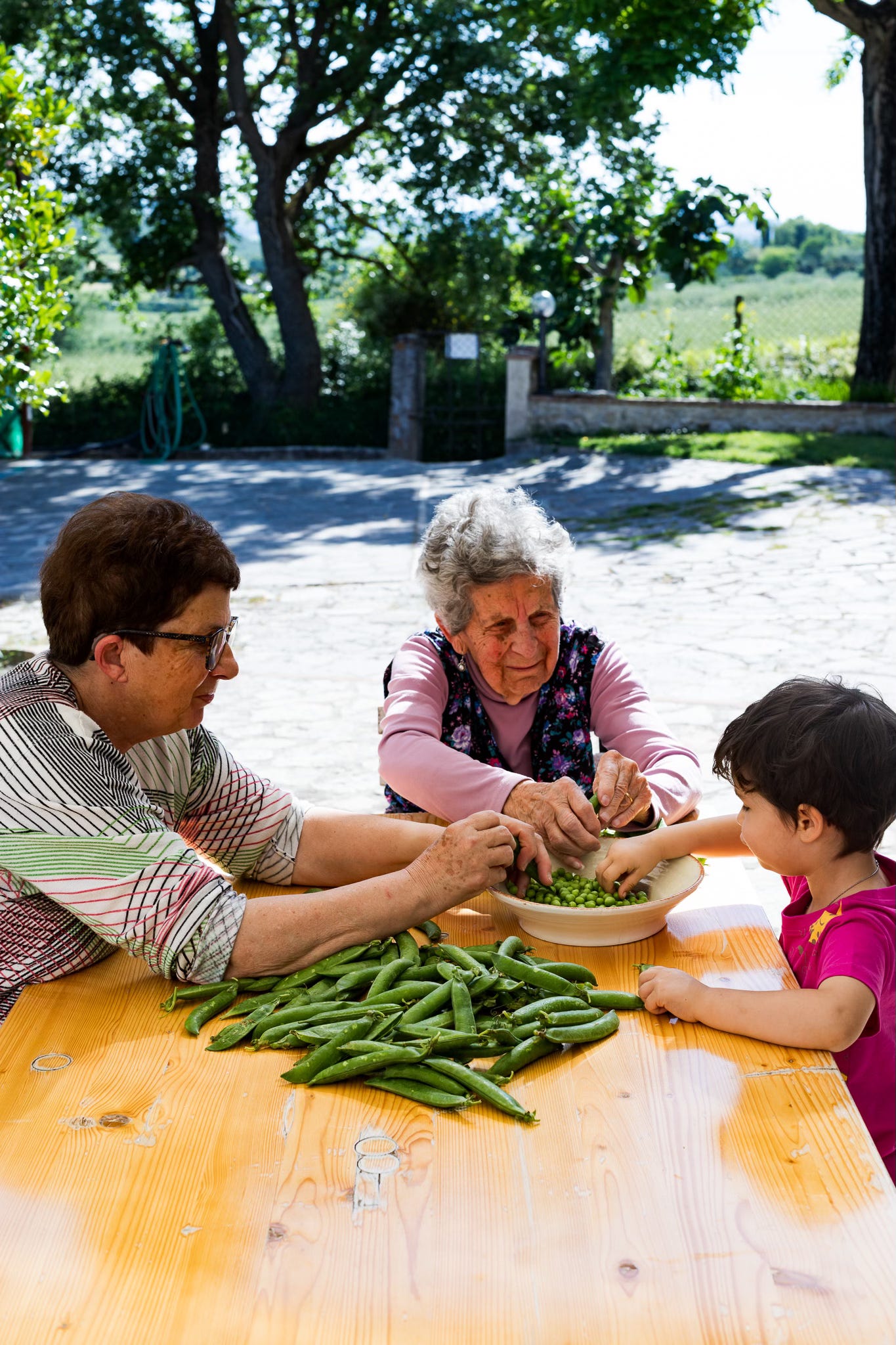
While I was growing up, she had a vegetable garden where she would grow artichokes, tomatoes, basil, green beans, lettuce, zucchini and zucchini flowers. She used to stuff them with whatever she had to hand: I remember once she managed to fill the blossoms with ricotta, minced ham, cheese and walnuts. They were delicious little hand grenades.
I inherited her passion for cooking.
She grew up in the countryside, in this very house where we’re living now, in a peasant family. She learnt to cook from the many women in her family — milk pudding from Zia Antonietta, meat sauce with rabbit liver from her mum — but also from those home cooks who would travel from household to household during threshing or grape harvest time, helping families lay out thank-you banquets for the neighbours who had come to lend a hand in the fields.
She had married into a Southern Italian family, so her cooking style soon incorporated Mediterranean ingredients such as dried oregano, eggplants, salted semolina bread (which she adored!), and sweet green peppers.
Her cookbooks
Pellegrino Artusi was her tutelary deity; his book, La Scienza in Cucina e l’Arte di mangiar bene (The Science in the Kitchen and the Art of Eating Well) was her cooking bible, a gift she had received on her wedding day from her best friend, Norma. I still keep it as a precious treasure, one of the 6 copies of this book I own. And yes, I know... I’ll have to tell you all about the other copies soon.
Alongside Artusi, there was Suor Germana and her cookbook Quando cucinano gli angeli (When the Angels Cook). Suor Germana was a nun whose cookbooks taught millions of Italians in the ‘80s and ‘90s how to prepare simple, ingenious food. Her motto was Dove non arriva il portafoglio, arriva il cervello, which roughly translates to: “When money isn’t enough, you have to get creative.”
Alongside these, nonna kept a couple of other vintage Tuscan cookbooks (the best way to trace some classic recipes back to how she actually made them), and she would also collect recipes from magazines, transcribe ones she heard on TV into her notebook, or jot down favourites passed on by family and friends.
Her signature recipes
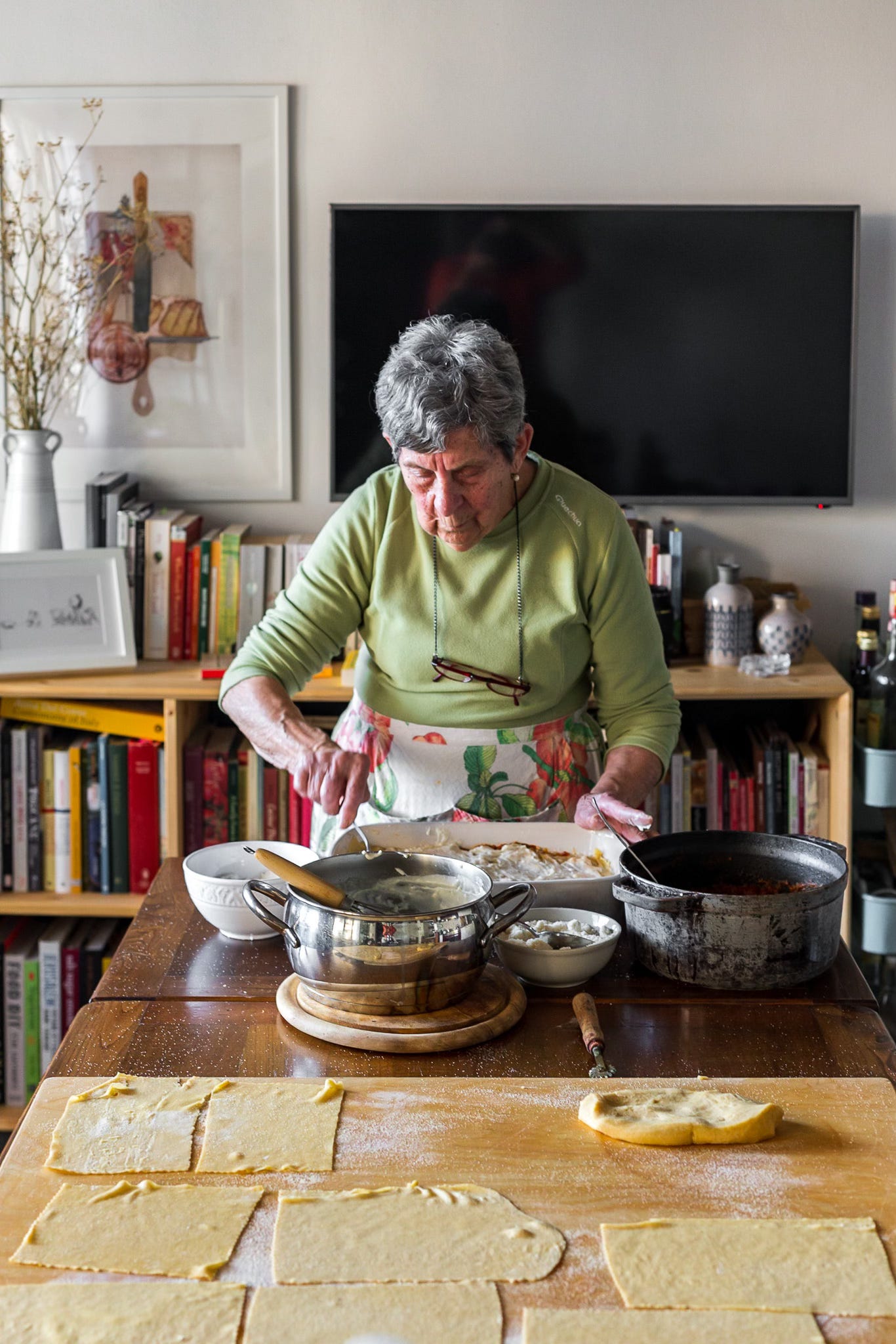
Among her signature recipes were her flawless lasagne (including a béchamel and porcini mushroom variation), her rice pudding cake, and her bignè alla crema, a hit at every birthday party or family gathering. These were giant choux pastries filled to the brim with a thick pastry cream. You needed to sit down and tackle them with both of your hands, carefully leaning forward to provide a safe surface for the pastry cream to fall on: better a saucer than your shirt.
But she was also famous for other genuine, uncomplicated dishes that we still instinctively associate with her, like her crostini with roasted peppers and mayonnaise, her stewed green beans, her tagliatelle with tomato paste, oregano, prosciutto cotto and cream, and the very best stuffed round zucchini.
She had a very personal idea of what a light lunch was: once, before I headed to the gym, she made me chicken stock with egg drop soup and a generous helping of shredded chicken! She made pasta e patate with extra cheese in winter to warm you up from the inside. She baked my birthday cake for decades.
Our lunch dates
When I moved out on my own, in 2013, I started having lunch with her every day: officially it was to keep her company, but I enjoyed our lunch dates so much. She would cook a little extra, I would bring down my latest experiments, and we’d spend an hour chatting and eating.
When Tommaso moved in from Florence a few years later, we kept a weekly lunch date: we would both go downstairs to eat with her, sometimes joined by my sister too. The table was always carefully laid, and there was always a little crostino to start the meal, or a few slices of salami, or some of her cured black olives.
The meal would invariably end with an espresso and a piece of chocolate.
She knew everyone’s tastes and preferences.
Sitting at her table, you always felt completely cared for.
Nonna loved Livia dearly.
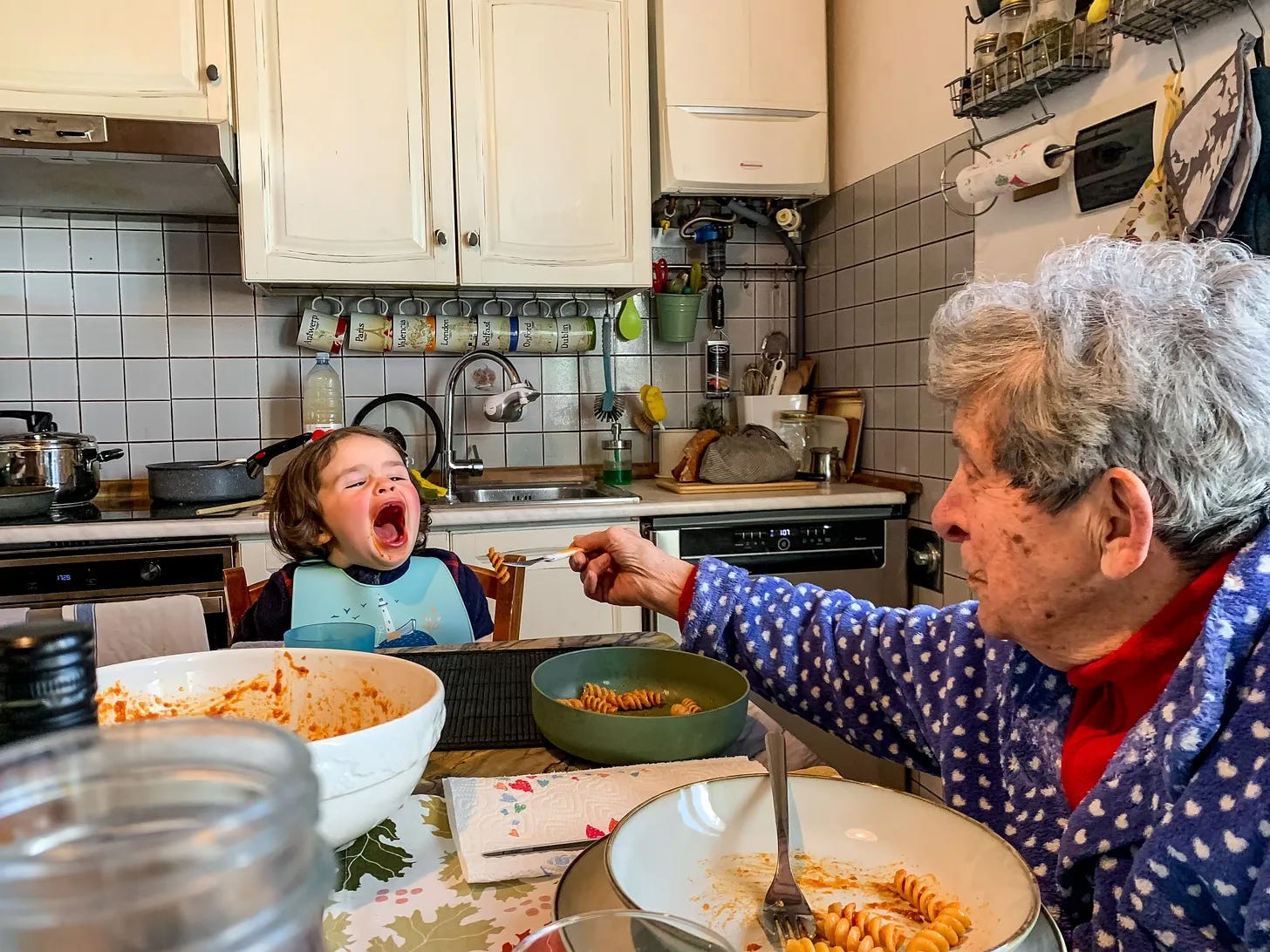
Becoming a great-grandmother at ninety-two brought a waft of energy and renewed enthusiasm into her life, especially as it was a year marked by the Covid lockdown. She loved spending time with Livia: feeding her, cuddling her, listening to her ditzy little songs, clapping along to her pirouettes.
We chose a star for nonna, to say our goodbye.
When I asked Livia what her favourite memory with nonna Marcella was, she replied without hesitation: pulire i carciofini con nonna, trimming baby artichokes together. I made sure they had those indelible moments together: trimming artichokes and green beans, shelling peas and broad beans.

She was meticulous, extremely reserved, and because of her character and upbringing, she showed her love through simple gestures rather than words: peeling you an apple, brewing you a cup of tea with a jar of biscuits on the table, or bringing you a magazine with a recipe or article she wanted to share.
Even though cooking was one of her strongest passions, she also loved gardening, reading, De André’s music (she used to sing me La canzone di Marinella as a lullaby), and had an insatiable passion for the Etruscans, whom she believed she was descended from, as her family, in the early 1900s, used to live in a nearby house built on an Etruscan tomb that doubled as a cellar. She had an ardent faith, and would always pray to Saint Anthony of Padua, asking her favourite saint to protect us.
She was the Italian nonna for all my foreign friends and, even though she was extremely shy, she always welcomed them with open arms, showing the same sense of hospitality her family had extended during World War II to partigiani and refugees from the nearby town.
Up until the very last day, she had a sweet tooth. She was very restrained in her meals, but she would never refuse a slice of cake. And it had to be sweet — really sweet — otherwise, what was the point of calling it a sweet?
When I told her I owed her my new life, my career, she replied, in a way that was so very her: Poor girl. You could have worked in an office, sitting at your desk, and now you’re spending all your day standing in the kitchen!
But she was indeed immensely proud of this. She kept all my books on her sideboard and, for a couple of years, collected the gardening magazine where I used to share recipes.

Keeping nonna’s legacy alive
When she passed away last June, I felt a strong urge to take care of the garden she had tended all her life, even though I certainly miss her patience, her skills, and the sheer determination to wake up every day at 6 a.m. in the summer to water all her flowers before the heat set in.
I decided it was time to learn how to forage for wild herbs to make salads and frittata, to recognise an edible landscape that has been a source of delicious dishes since time immemorial, during the harsh times of war, when foraged greens were an essential part of the diet, and in more modern times, when a salad made with wild chicory, dandelion and sow-thistle was a delicacy rather than a necessity.
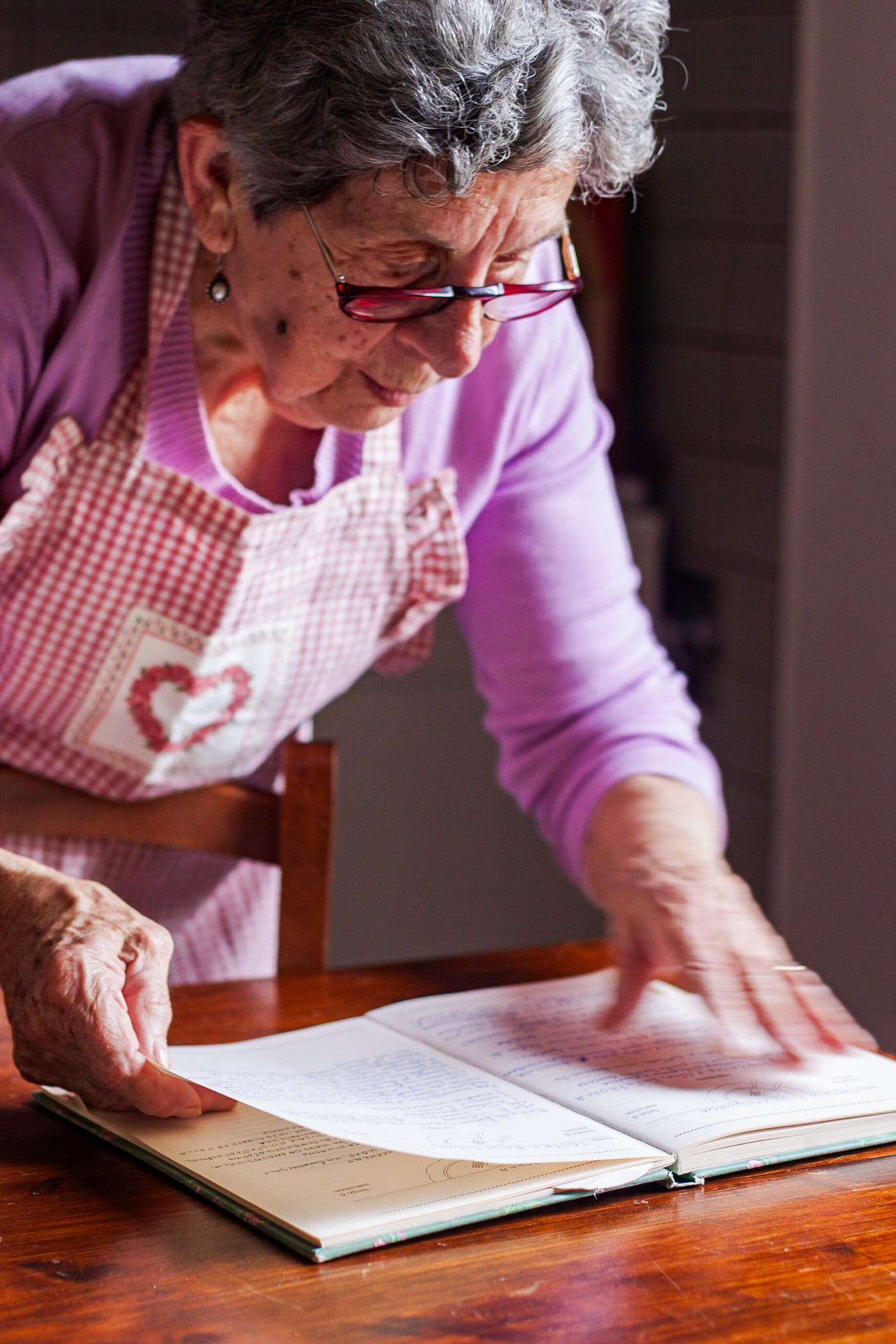
Even though first my blog, and then this newsletter, have served as a digital archive of all her dishes and stories for the past eighteen years, I felt an even deeper commitment to preserve her recipes.
Not as immutable entities frozen in time, not as a constraint to do something in a certain way just because we’ve always done it like that, but recipes as living creatures, familiar answers to timeless questions such as: what can I make for dinner when it’s tomato season? What do I cook when there’s a loved one to feed and console? How can we celebrate Easter?
Well, I know the answer to that last question. It will always be fresh tagliatelle.
I’ve always loved Tuscan cuisine, and have found its traditional gastronomy incredibly fascinating, the seasonality applied not only to vegetables but also to desserts and meat, the central role of stale bread and olive oil, and the ancient yet strikingly modern focus on plant-based proteins, especially beans.
Now that she is no longer here, I feel an even deeper responsibility to protect, respect, and pass on what I learnt from her. Cooking is how I will keep her with me.
Tradition is not the worship of ashes, but the preservation of fire.
— Attributed to Gustav Mahler, quoted in Eating to Extinction by Dan Saladino
More newsletters related to the role nonna had in my life:

While I was writing this letter to nonna, more and more thoughts kept bubbling up, a flurry of memories, questions, readings and reflections on what tradition truly means, and how traditional food continues to shape the way I cook, eat, and live. It’s a thread that runs deep, and I realised I had far too much to say for just one letter.
So, expect a part two soon, a continuation of this journey through memory, food, and tradition.

I’m closing today’s letter with one of her most famous recipes, something she used to make often in winter. As we’ve been talking a lot about candied citrus peels in the last week, here’s her recipe for quick, thin candied orange peels dipped in chocolate. What a treat!


