
A winter project worth waiting for: candied citrus peels
From first peel to final jar, followed together in a subscribers-only chat

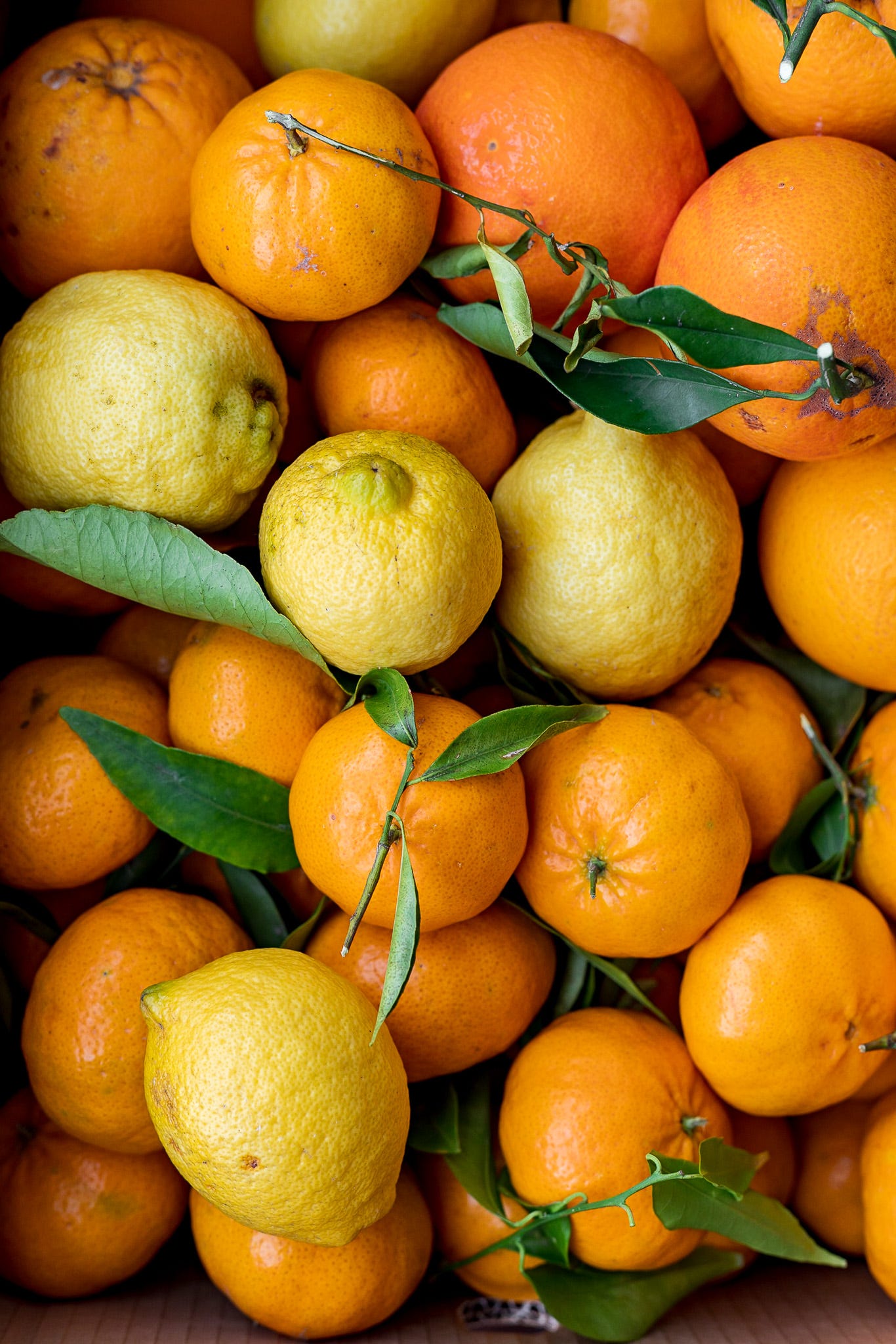
I find it deeply satisfying to spend time preserving the best produce of the season for as long as possible. There are jams and marmalades, and don’t even get me started on the liqueurs—limoncello, bergamot liqueur, nocino, alchermes… I might sip them once a year, but that’s not the point for me. It’s the pride I feel when I line them up on the table after a dinner with friends or a cooking class. It’s homemade food at its best.
Over the last few years, since my home production of local Christmas treats such as panforte and cavallucci has taken on pastry shop rhythms, I decided to go the extra mile and start making my own homemade candied orange and citron peels, key ingredients in these festive treats. Once you have good candied peels, though, you’ll find endless ways to use them: added to whipped ricotta as a filling for a sponge cake, thinly sliced and dipped in dark chocolate, as a decoration for an intensely citrussy pound cake, in an Easter pastiera or for a Sicilian cassata…
High-quality artisanal candied peels come with exorbitant price tags (though totally justified, given the amount of time it takes to make them), while the flavour of the cheaper store-bought, neon-bright, preservative-rich ones simply can’t compare.
Making your own candied peels cuts down the costs while rewarding you with the most fragrant jewels you’ll ever taste.
As soon as I see thick-peeled citrus fruits on the market stalls, I compulsively buy them and bring them home by the bagful. I also eat tons of oranges anyway, so I had to come up with an idea to use all their peels. I became so passionate about candying my own peels that now, whenever someone eats an orange around me, they turn to me with a terrified look and quickly ask, “How do you want the peel? The whole skin, pith included? Just the thin zest, to make marmalade? Is that OK?” (The whole, thick skin, with all the pith, in large and regular segments, is good for making candied peels.)
A few years ago, when my parents asked me what I wanted for Christmas, I gave them a list for marmalade lovers: a jam funnel, jam jar tongs, and a refractometer (something you can easily buy online). This last geeky tool, which looks like a kaleidoscope, is used to measure Brix degrees, which indicate the density of sugars in a liquid. It comes in handy for making marmalades and candied peels at this time of year, but obviously, it is not essential.
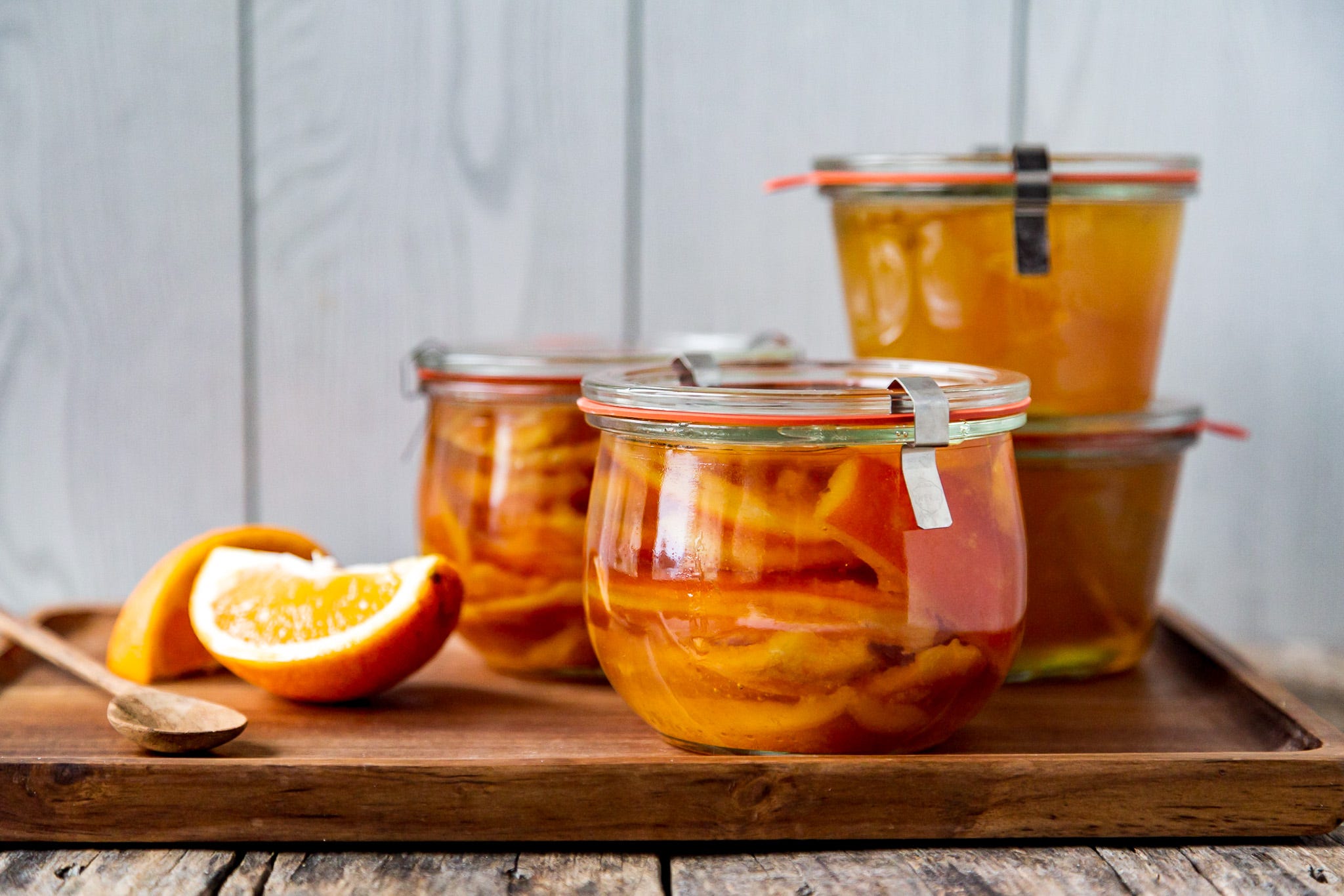
Making candied orange peels from scratch is not difficult; it just requires patience and dedication.
The hands-on time is minimal, but you will need to wait 7 to 10 days for the candying process to finish. On the plus side, the pot of fragrant peels and syrup will make your kitchen smell incredibly fresh and citrusy for days.

Just before the holidays, during our December live cook along when we made panforte together, I told you that I was planning to make my own candied citrus peels in January again. The time has come.
I found some lovely organic oranges and citrons from Sicily, I got them shipped here along with a box of avocados, and now I’m ready to make my annual batch of candied peels, to use throughout the year in my cakes and cookies.
The recipe has been living on the blog for almost a decade now, but I wanted to make the whole process a lot easier for you to follow.
First I thought we could make a cook along, but it wouldn’t cover the length of the process, so I thought I could open a dedicated subscribers’ chat where to post the whole process as I go, something you can access and refer to, especially if you’re planning to make them this year.
So how does it work?
First of all, I created this special chat, open to all paid subscribers.
I will start collecting orange peels and citron peels and keep them in a bowl of cold water. In a couple of days I’ll start uploading photos and/or short videos into the chat, where you can follow along the making of the candied citrus peels. I’ll guide you through every step, and I’ll be available to answer questions on the candying process and check your photos for doneness.
This is how you make them, step by step.
Collecting the peels
You probably won’t have all the orange peels you need in one go, so collect them over time while you (and maybe your family) eat your oranges.
First, slice off the top and bottom ends of each orange. Then use the tip of a knife to carve the peel into large segments, from end to end, and use your fingers to gently remove each segment, being sure to include the white pith.
Collect the peels in a plastic container, cover them with cold water, and keep them in the fridge for up to a week. Change the water twice a day; this will also help take away the bitterness of the peel. When you have the amount you need, start the candying process.
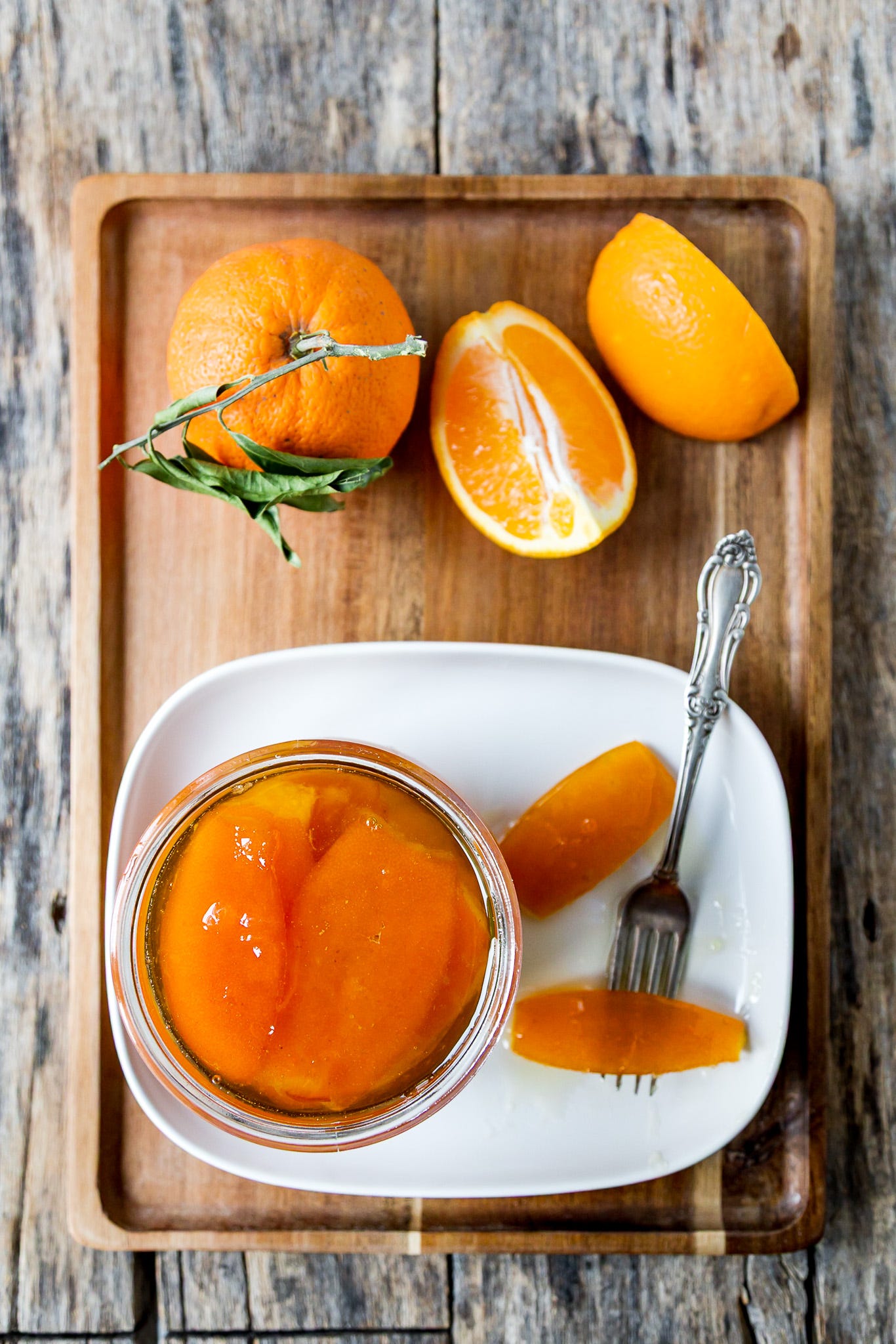
RECIPE - Candied Orange Peels, hot to make them at home
Some people say to double the weight of the peels to get the weight of water and sugar needed; others suggest multiplying by three, to make sure you have enough syrup for storing. After trying both ways, I’ve decided that the perfect amount for me is two and a half times.
So use this ratio by weight: 1 part peels to 2½ parts water and 2½ parts sugar. For every 100 grams of peels, you will need 250 grams of water and 250 grams of sugar. This will help you easily scale down or up if you have a smaller or bigger amount of peels.
At the end of the process, you’ll add some glucose or honey to prevent the peels from crystallizing or becoming too hard.
If you have some leftover syrup from the candying process, keep it in the fridge in a jar. Use it to brush over cakes or make sorbets and refreshing drinks in the summer.
Makes 3 medium jars
500 grams organic orange peels, pith included, cut into large, even segments
1,25 l water
1,25 kg sugar
300 grams glucose, or acacia honey
Prepare the orange peels. Fill a pot with water and add the peels. Bring the water to a boil. As soon as it starts boiling, drain the peels and cool them down in a bowl of cold water. Repeat this process of blanching the peels two more times. The last time, instead of removing the peels as soon as the water starts to boil, simmer them for at least 30 minutes, or until the white pith becomes translucent. Gently drain the peels and cool them again in cold water.
Once cold, drain the peels and let them drain well on a wire rack.
Candy the peels. Pour the water and sugar into a large pot and stir well. Heat over medium-low heat until the sugar has completely dissolved, and the syrup starts to simmer.
Turn off the heat immediately and add the orange peels into the hot syrup, making sure they are entirely covered by the syrup. Let cool completely, cover the pot (do not cover while warm or hot, or condensation from the steam will drip into the syrup), and leave until the following day.
The next day, heat the syrup and orange peels. As soon as it starts to simmer, turn off the heat. Wait again until the following day.
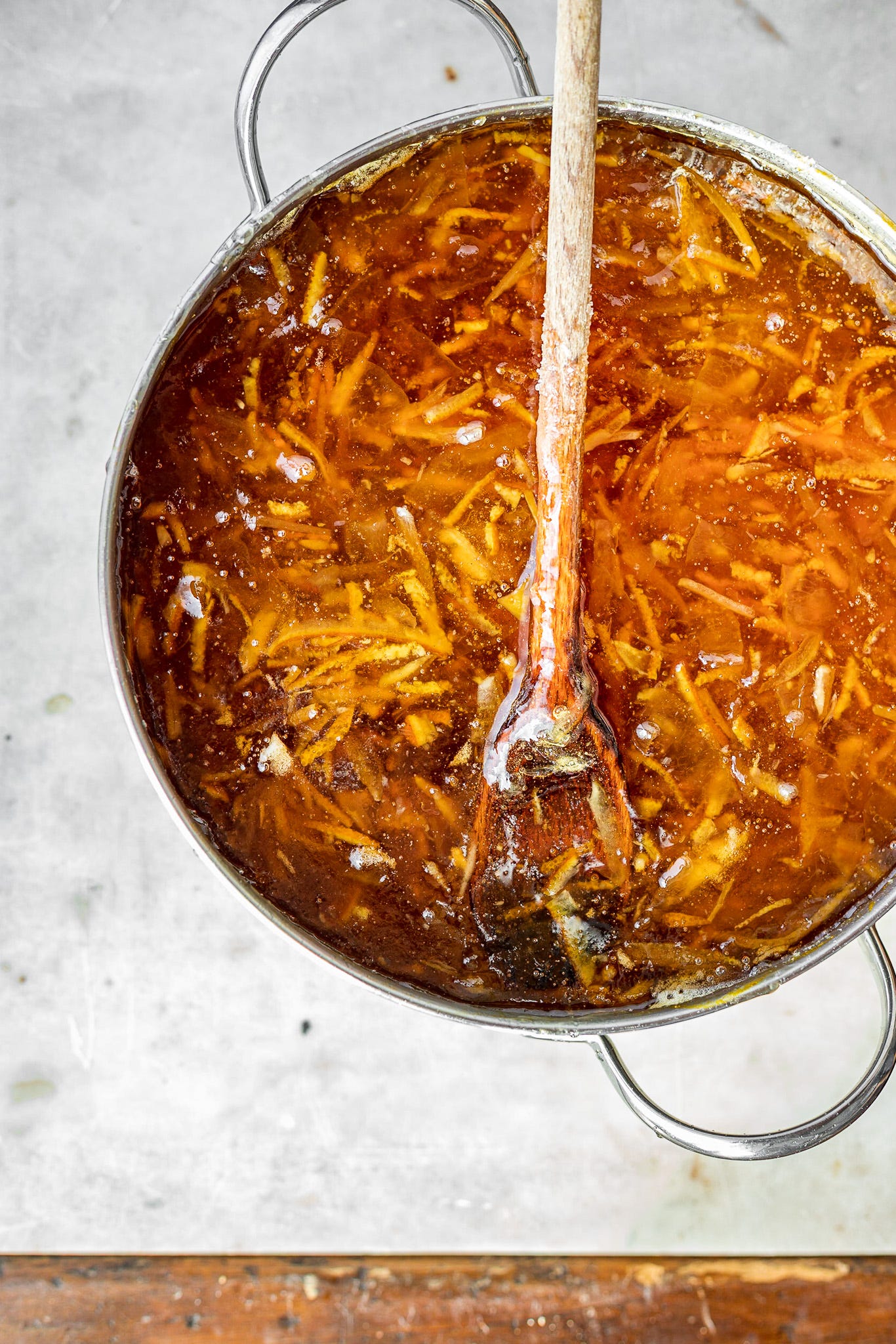
Repeat this process for 7 to 10 days; the syrup will thicken day by day, becoming stickier. How do you know when the peels are ready? Eventually, a film will form on the surface, and the syrup will be almost as thick as honey. For the geeks out there, use a refractometer, the tool that measures sugar concentration: The peels will be candied to perfection when the syrup reaches 72 degrees Brix.
When the peels are ready, add the glucose or the acacia honey, stir carefully until dissolved, and bring to a boil for the final time.
Preserve the candied peels. Collect the hot candied peels into sterilized jam jars, cover them with syrup, and seal the lids.
Put the jars in a large pot and add water to cover them by a few inches. Bring the water to a boil, then reduce to a simmer and set a timer for 20 minutes. When the timer goes off, remove the pot from the heat and let the jars cool completely in the water before removing them.
Store the sealed jars for up to a year in a dry, cool, and dark place. Refrigerate the jars after opening.
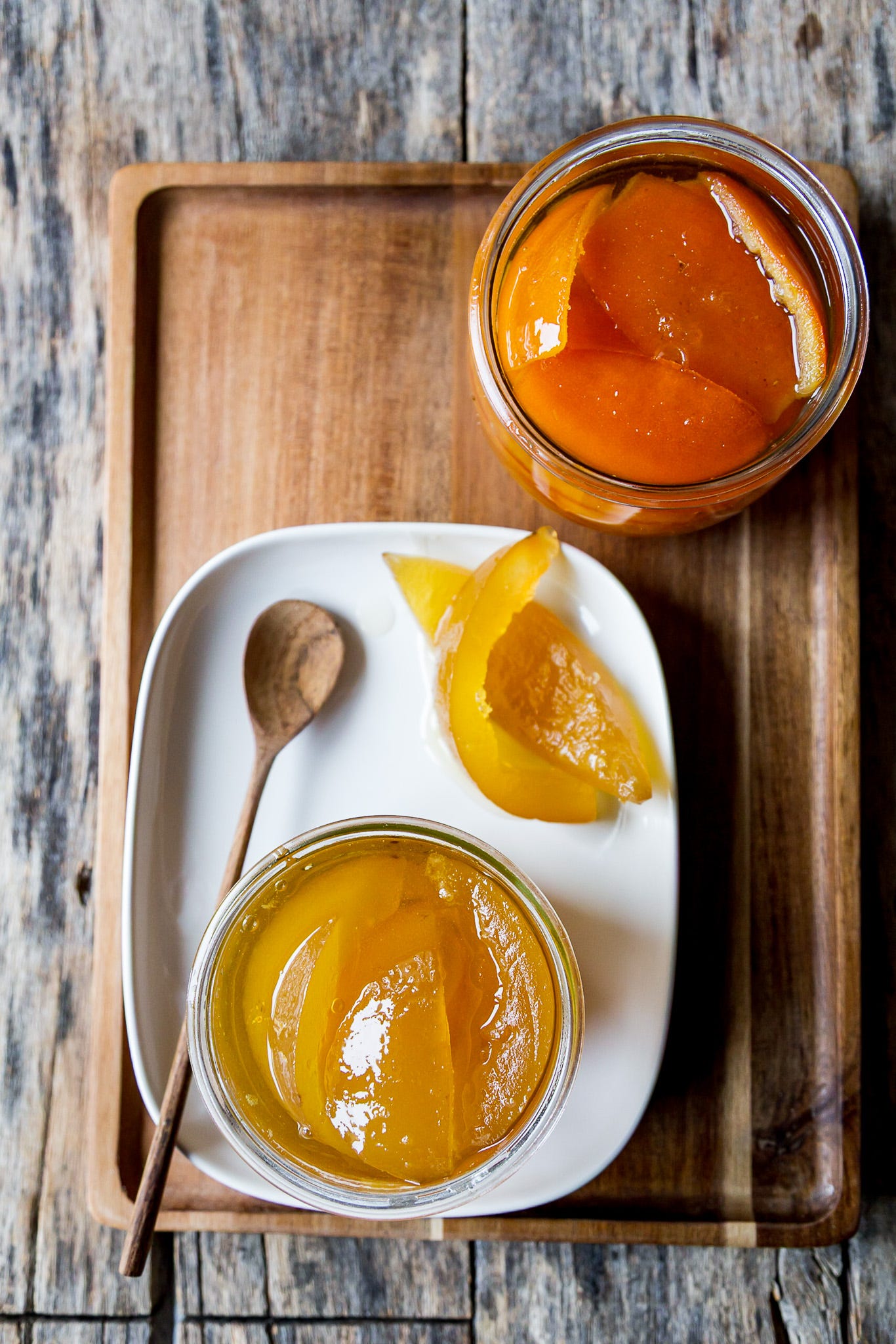
Candied citron peels, how to make them at home
The exact same procedure can be applied to citron peels. In this case, cut the citron in a half, and then in quarters. With a sharp knife cut away the pulp and keep the white pith, which will be thick and firm. Depending on the thickness of the peel, it may take a day or two more than orange to candy.
Do not throw away the pulp. You can add it to a marmalade (and we’ll talk about it next week) and also slice it thinly into a salad. The citron, if possible, is even more charming than the orange once it has been candied.
More recipes with citrus fruit
In winter I am full of energy and even my jam production enjoys a new momentum. The days I spend making citrus marmalade are among the happiest of the season: I get slightly tipsy with the essential oils and I am mesmerised watching the jam simmering away. I feel I am something in between a modern alchemist and a witch, among jars, ladles and pots. Here’s a few ideas to enjoy the season of citrus fruits:
Bitter orange marmalade. This bitter orange marmalade is made the traditional way, using only Seville oranges, sugar, and patience—no added flavours, no shortcuts. Bitter oranges appear briefly in winter, and when they do, they deserve your full attention. This is a preserve you make once a year—and remember for much longer.
Citrus marmalade with oranges, lemons, bergamots and citron. This mixed citrus marmalade is balanced and cheerful. You taste the sweetness, the bitterness, an incomparable freshness and the lemon acidity. It makes you love it, and for this reason it is perfect as a gift, because you can enjoy it on toast for breakfast, as a filling for a sponge cake or as an ingredient to glaze a piece of pork to caramelise in the oven.
Bergamot marmalade. Bergamot is so acid in its natural form that cooks ignored it for centuries. It was even categorized as a toxic substance. Recently producers of quality bergamots from Calabria fought to remove this wrong toxic label and nowadays they are developing new interesting products to promote other uses of bergamot, which are not just related to extracting its precious essential oil: now you can find also bergamot bases marmalades, cordials and syrups.

Orange pow(d)er
Every year I fill a jar with this fine powder with an intensely orange scent and use it sparingly since the end of the orange season in biscotti, cakes, but also in risotti and with fish to substitute the freshly grated orange zest, one of the most celestial smells in the world.
I recently discovered that what I believed to be a new way to preserve the orange aroma throughout the hot months was instead an old remedy, something my grandmother has always done. They would dry up the orange peel next to the fireplace and crumble it in cakes and biscotti when needed. Those women had never thrown something away, let alone the peel of a fruit as precious as an orange.
So how do you make it nowadays? Remove the orange zest with a peeler. Collect it on a wire rack and dry until brittle next to a stove, on a radiator or near the fireplace. You can also dry them up in a dehydrator and in the oven at low temperatures. Be careful as the orange zest is so thin that it burns up easily. When you have a good amount, blend them into fine powder in a spice blender. Collect this powder with a brush in a jar. It can be kept for several months, preserving its aroma intact.
You can follow the same procedure for clementines and lemons.
I’m going to start saving all my orange peels. 😊 it’s hard for me to find citron. I bought some lemons. I’ll candy those but what do you use candied lemon in? Also if I am doing both oranges and lemons should they be in separate pots? I can’t wait to start. I may have to peel a bunch of oranges. Maybe make a cake💕
Thank you. I made them a few weeks ago and forgot how I measured. Fabulous recipe