
Long live tomatoes!
A small kitchen disaster, the best tomato recipes from the archive, and pomodori a mezzo from Roman Jewish cooking.

Despite my best efforts, the many planners lying open beside me, the fans whirring, and the litres of refreshing herbal tea I drink every day, I did not manage to publish the newsletter I had planned for today.
I could blame the savoury tart I wanted to share, which collapsed all over the marble kitchen table when I tried to remove it from the tin. But I have to admit that it needed another round of testing anyway before it could earn the approval of my toughest judge, Tommaso.
I promise I will keep working on it and tell you all about it soon. In the meantime, I hope this small kitchen disaster reassures you that the recipes that make their way here are always tested thoroughly—even if the process is not entirely free from mishaps.
So as not to leave you without inspiration for the weekend, I decided to gather together everything I have written about tomatoes over the years. Because, once again, they are going to save not only my lunch, but this week’s newsletter too.
So, long live tomatoes!


The smell of tomato leaves is something I instantly associate with childhood summers, spent trailing after my grandma in her garden. I remember the towering walls of tomato plants, climbing up slender reeds she arranged almost like little tepees.
I was known for biting into green tomatoes straight from the vine, stubbornly ignoring the sweet, juicy red ones. I only began to appreciate them properly in my teenage years, thanks to a preserved mackerel and tomato salad that Nonna prepared for lunch one day.
These days, the tomatoes grow in raised beds that my dad built during the Covid years, using recycled wooden planks, old shutters, shelves, anything he could find. And I still love the green, unmistakable scent of their leaves, even if now I choose only the ripest, heaviest tomatoes for my quick summer meals.
When we stop at the vegetable stall during a summer market visit, tomatoes — in all their shades, shapes, and varieties — steal the show from everything else.
Big or small, thick-skinned or full of juice, bright red or tinged with pink, firm to the touch or heavy and ready to become sauce: we could talk for hours about the many types of tomatoes and how best to use them in the kitchen.
Ciliegini, datterini, fiorentini, cuore di bue, canestrini, San Marzano... Some of these tomatoes have proper names, some are defined by their place of origin or their shape. And then there are the countless varieties you can grow in your own garden, heirloom tomatoes whose seeds have been passed down from one generation to the next.
If you’d like to dive deeper into the world of Tuscan market tomatoes, I wrote a longer piece about them a couple of years ago. You can find it here in the newsletter archive.


Here are some of the recipes where a really good tomato makes all the difference:
Eggs stewed in tomato sauce. Think of it as the Tuscan version of shakshuka or eggs in purgatory. My nonna’s recipe sits in between eggs poached in tomato sauce and scrambled eggs: first the whites are quickly folded into the tomato sauce, then the egg yolks are nestled in the sauce and cooked until barely set.
Pane al pomodoro, bread and tomato. I am not sure you really need a recipe for bread and tomatoe. Or perhaps you do? I have never been much of a bruschetta person, mostly because whenever I try to eat one, the chopped tomatoes inevitably tumble everywhere. Perhaps it is because I grew up eating pane al pomodoro: a tomato—ideally a ribbed costoluto fiorentino—rubbed directly onto a slice of unsalted Tuscan bread until the crumb turns deep red. Then comes plenty of extra virgin olive oil, salt, and oregano.
Roasted tomato soup. Now that tomato season is reaching its peak, bringing us juicy, sun-ripened fruit bursting with flavour, this is the best time to make it.
Pasta alla crudaiola, raw tomato sauce for pasta. This is the purest form of pasta al pomodoro, perfect for late summer tomatoes, when their flavour is so intense that they need neither cooking nor much else to become a sauce. Crudaiola comes from the word crudo, raw, as you’re going to use raw tomatoes to make this sauce, along with fresh basil, garlic, extra virgin olive oil, salt and pepper.
Burst cherry tomato sauce for pasta. The small, plump tomatoes burst in the heat and melt into the olive oil, becoming a chunky sauce flavoured with basil and garlic. Isn’t it the quintessential taste of an Italian summer? A little chilli adds gentle heat and a handful of pine nuts adds texture to the sauce.
Roasted tomato risotto. Simple as the ubiquitous pasta al pomodoro, and equally satisfying and comforting, risotto al pomodoro is an everyday dish that you can make special by using a roasted tomato sauce and a generous spoonful of stracciatella.


Here are a few more recipes from Cucina Povera and Vegetables the Italian Way:**
Pappa al pomodoro, from Cucina Povera, p. 239
Roman-style rice-stuffed tomatoes, from Cucina Povera, p. 43
Panzanella, from Cucina Povera, p. 250
Pantelleria-style salad, from Vegetables the Italian Way, p. 23
Tomatoes with tonnato sauce, from Vegetables the Italian Way, p. 20
Spicy tomato jam, from Vegetables the Italian Way, p. 225
**The Italian translation of Vegetables the Italian Way is moving forward, and I am realising just how far it goes beyond a literal translation: it is also a process of cultural and structural adaptation.
The book was written directly in English, so we are now taking the journey in reverse, a process that is proving both fascinating and cathartic. It feels deeply moving to return to writing in Italian.
What tomato recipe always comes to your rescue at lunchtime? Tell me about it in the comments, or simply reply to this email. I always love hearing from you!


And finally, today’s recipe: pomodori a mezzo
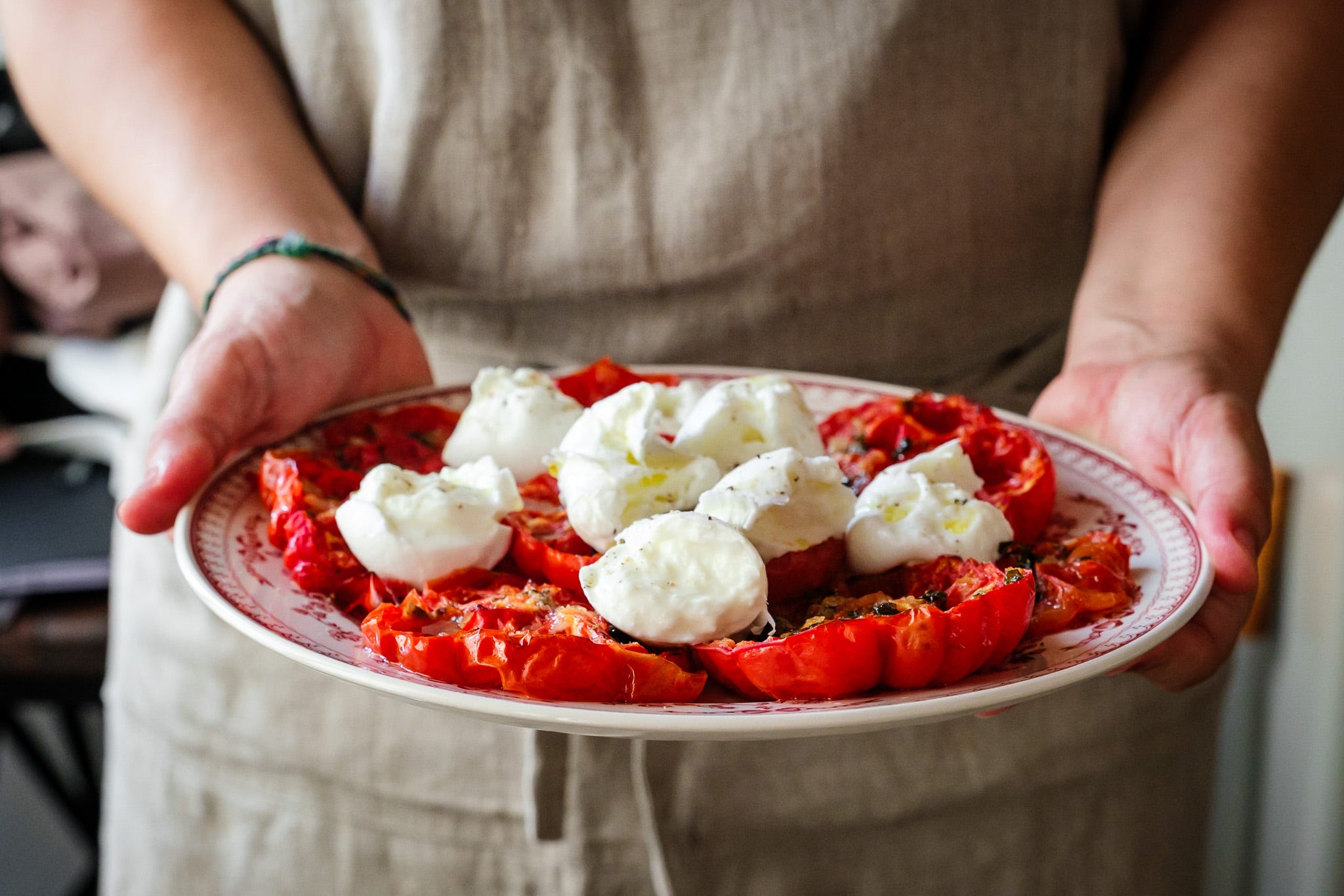
Pomodori a mezzo literally means “tomatoes cut in half,” which is exactly how they are roasted in the oven, generously dressed with olive oil, garlic, and herbs.
I first discovered this traditional dish from Roman Jewish cuisine a few years ago through my friend Barbara Toselli, who had shared the recipe on Instagram. Whenever someone mentions roasting a vegetable in copious amounts of olive oil—I cannot remember whether those were her exact words, but that is certainly what my brain took away from it—I am immediately won over.
Love the caption 🤓
You must be a magic tomato fairy! Yesterday I went for a walk in my very suburban neighborhood thinking about this post and there was a small fruit and veg stand that was selling boxes of tomatoes! I was wishing for that and there is was! I've never seen someone set up a kiosk like that under some trees, beside a religious building so people leaving after service could buy produce. I now have 8 + kilos of tomatoes waiting for me to try some of these recipes.